Customer goal
Unity UX Design System & Design Ops
A shared design-system ecosystem and operating model that aligns design and development across Porsche Holding brands, products and customer journeys.
Project notes
Team goal
Give product teams one reusable foundation of tokens, core components and governed product libraries instead of rebuilding the same solutions.
The challenge
Build a system that creates real consistency without removing the flexibility each brand, product and technology stack needs.
01 / Why Unity UX
From duplicated effort to one shared foundation.
Before Unity UX, product teams often solved the same design challenges independently. The result was duplicated effort, inconsistent interfaces and fragmented customer journeys across brands and products.
We created Unity UX as the shared design system for Porsche Holding’s customer-facing digital products. It brings reusable foundations, tokens, components and interaction patterns together so teams can create consistent, accessible and scalable experiences without erasing product-specific needs.
02 / Vision
Consistency across every journey and brand.
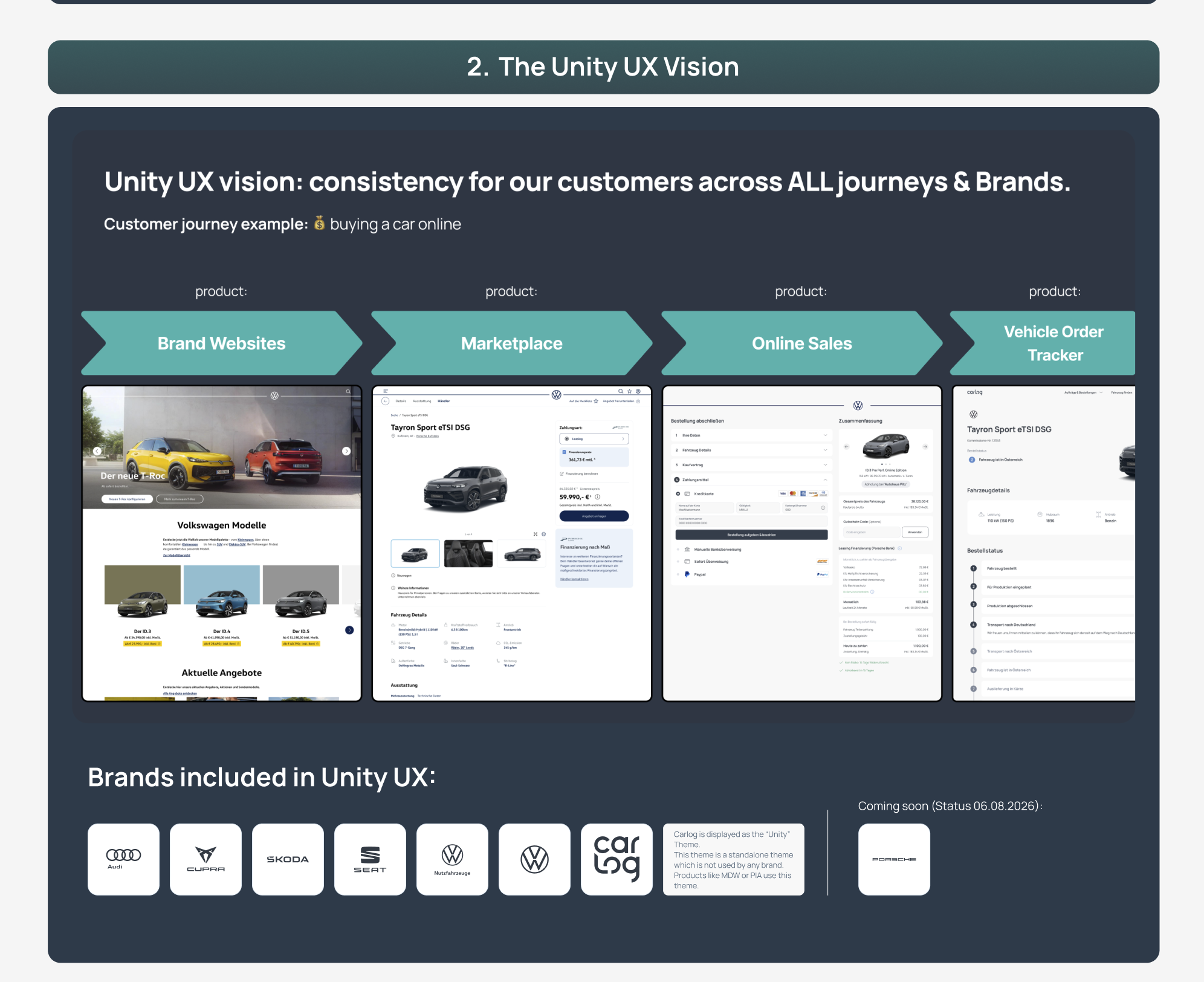
The vision reaches beyond a component library: customers should experience one coherent ecosystem as they move from a brand website to Marketplace, Online Sales and the Vehicle Order Tracker.
Unity UX supports Audi, CUPRA, Škoda, SEAT, Volkswagen Commercial Vehicles, Volkswagen and the brand-neutral Carlog theme, with Porsche joining the ecosystem next. The shared foundation keeps the journey recognizable while each brand retains its own visual expression.
03 / System Architecture
One core, extended through product libraries.
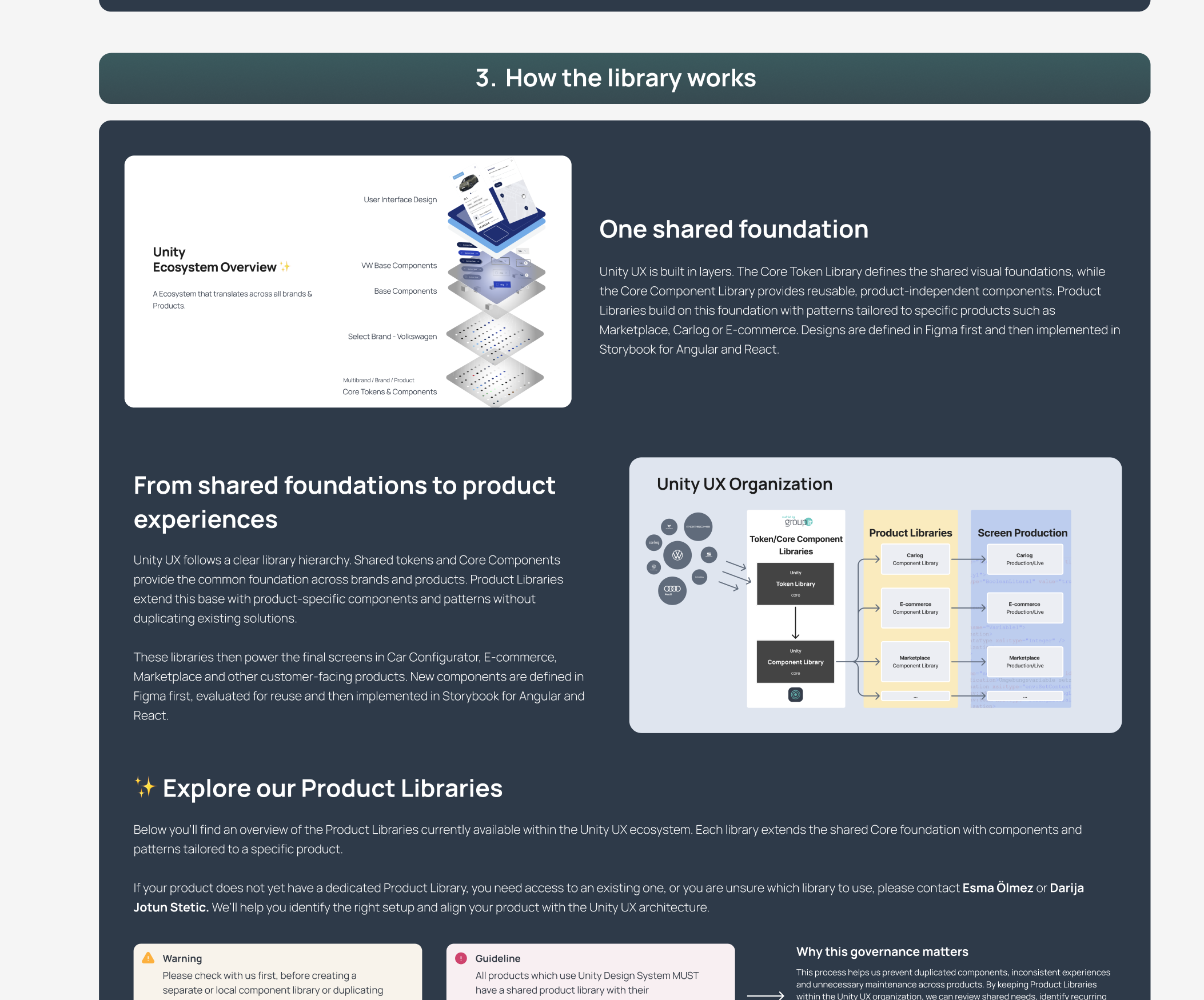
Unity UX is built in layers. The Core Token Library defines the shared visual foundations, and the Core Component Library provides reusable, product-independent components. Product Libraries extend that foundation with patterns tailored to Marketplace, Carlog, E-commerce and other products—without duplicating existing solutions.
New components are designed in Figma first, evaluated for reuse and then implemented in the central Storybook for Angular and React. This hierarchy lets teams move faster while keeping the experience consistent, accessible and maintainable across design and code.
04 / Design Ops & Governance
Turning the library into an operating model.
The system only works when contribution and ownership are clear. I shaped the Design Ops model around one governed flow: request, ticket review, prioritization, design review, design QA, publishing, delivery, implementation and development QA.
Product Libraries remain inside the Unity UX organization so recurring needs can be reviewed across teams. Patterns that benefit multiple products move into the Core Library; local duplication is avoided. Jira connects design and development work, while changelogs, reviews and approvals make decisions traceable.
Today I lead the Design and DevOps team together with our agency. My role combines Unity UX ownership and strategy with facilitation, prioritization, governance and the day-to-day alignment needed to turn the system into a sustainable cross-functional practice.
05 / Outcome
The next chapter: Unity Pitlane.
Unity UX changed more than interfaces. It introduced a culture of shared ownership, reuse and continuous collaboration between design and development across Porsche Holding.
We are now extending that culture shift to our back-office systems with Unity Pitlane: a dedicated design-system ecosystem for internal operational products. It will carry the same principles—shared foundations, clear governance and design-to-development alignment—while being shaped around the workflows and needs of back-office users.